I’m Sezai Aramaz, a practising electrician in my 40s and a lecturer with over 20 years of teaching experience. At Learn Trade Skills (LTS) we train electricians every week who want to move into renewables: EV charge‑point installation, solar PV and electrical energy storage systems (EESS).
This guide pulls together the official rules and requirements from regulated and government bodies – not marketing – and explains how the City & Guilds renewable installation qualifications (which we deliver at LTS) fit into that framework in 2025.
1. Why renewable installation skills matter now
The UK’s climate law commits us to bring all greenhouse gas emissions to net zero by 2050 That target drives big changes in:
- how we power homes (solar and batteries),
- how we heat and cool buildings, and
- how we move around (EVs instead of petrol and diesel).
The government’s official guidance on electric vehicles states clearly that the transition to EVs is a crucial step towards achieving the UK’s net zero target, and provides dedicated guidance on EV charging and infrastructure.
At the same time, the Department for Transport publishes quarterly electric vehicle public charging infrastructure statistics. The latest release (October 2025) shows continued growth in publicly available EV charging devices across the UK, with data broken down by local authority. That expansion only happens if there are enough qualified installers.
On the skills side, the government’s Clean Energy Jobs Plan, published in 2025, highlights electricians and other skilled trades as central to delivering clean power and net zero, and positions clean energy as a major source of “good jobs” across the UK.
So if you’re an electrician thinking about EV charging, solar PV or battery storage, you are right in the middle of a long‑term national priority – not a short‑term trend.
2. Who actually sets the rules? (Qualifying and regulatory bodies)
Before we talk about courses, we need to be clear who does what.
2.1 Government and Ofqual
- The Department for Energy Security and Net Zero (DESNZ) leads on the UK’s Net Zero Strategy and wider climate policy.
- Ofqual is the regulator for qualifications in England and Northern Ireland. It runs the public register where you can “find a regulated awarding organisation” and “find a regulated qualification”, so you can check that a qualification and its awarding body are officially recognised.
In Ofqual’s published dataset of recognised awarding organisations, The City and Guilds of London Institute (City & Guilds) appears as a recognised awarding organisation.
That means City & Guilds qualifications – including the EV, PV and EESS courses we deliver at LTS – sit inside the UK’s regulated qualifications framework.
2.2 City & Guilds – the qualifications themselves
City & Guilds has developed a suite of Level 3, CPD‑style renewable installation awards for practising electricians:
- EV charging
- City & Guilds 2921 – Level 3 Award in the Requirements for the Design and Installation of Domestic and Small Commercial EV Charging Installations (2921‑34), plus a related large‑scale EV charging design award (2921‑32).
- Solar PV
- City & Guilds 2922‑34 – Level 3 Award in the Installation and Maintenance of Small Solar Photovoltaic Systems.
- Electrical Energy Storage Systems (EESS / batteries)
- City & Guilds 2923‑34 – Level 3 Award in the Design, Installation and Commissioning of Small Electrical Energy Storage Systems.
The handbooks for these qualifications make three key points that matter for you:
- They are supplementary short courses aimed at practising, competent electricians – not entry routes for complete beginners.
- Entry requirements are aligned to the Electrotechnical Assessment Specification (EAS) – the industry benchmark for competence used by Competent Person Schemes (CPS) and others.
- City & Guilds explicitly links these qualifications to net zero and sustainability, stating that it is committed to reducing its own emissions and supporting qualifications that help organisations understand their environmental footprint.
2.3 ECS Gold Card and industry competence
The Electrotechnical Certification Scheme (ECS) and Joint Industry Board (JIB) set the occupational benchmark for electricians working unsupervised:
- ECS states that the industry expects unsupervised electricians to hold the ECS Gold Card, underpinned by an industry Level 3 electrotechnical qualification (usually NVQ/apprenticeship) plus current BS 7671.
A City & Guilds EV/PV/EESS course is not a substitute for that Level 3 core qualification – it builds on it.
2.4 Electrotechnical Assessment Specification (EAS)
The EAS is published through the IET and Electrical Safety First. It sets out the competence requirements that government‑authorised Competent Person Schemes (CPS) must use when they register electrical enterprises and Qualified Supervisors for self‑certification under the Building Regulations
The City & Guilds entry requirements we’ll look at in a moment explicitly reference the EAS qualification tables.
2.5 Microgeneration Certification Scheme (MCS)
For solar PV and EESS, the Microgeneration Certification Scheme (MCS) is the key quality mark.
- MCS describes itself as the UK quality mark for small‑scale renewable technologies like solar PV and battery storage, with two main roles: setting and maintaining standards, and providing consumer protection.
- For solar PV, MIS 3002 sets technical requirements for MCS‑certified contractors, covering design, installation, commissioning and handover of PV systems up to 50 kWp.
- For battery storage, MIS 3012 (the Battery Installation Standard) does the same for EESS up to 50 kW, referencing the IET Code of Practice for Electrical Energy Storage Systems.
These standards apply mainly to businesses (contractors) rather than individual electricians, but they shape the skills and qualifications the industry expects.
3. Entry requirements: what you actually need before you book
You asked specifically:
“I think for any renewable course you need either be registered to a CPS or fully qualified gold card holder (please recheck this info).”
Let’s go to the official City & Guilds documentation and see what it really says in 2024–2025.
3.1 The common pattern
For all three City & Guilds renewables qualifications (EV, PV and EESS), the learner entry requirements are very similar. In summary, the handbooks state that:
- The course is intended for practising electricians.
- Eligibility must be confirmed against specific entry requirements.
- Centres must keep evidence for 3 years that each learner meets those requirements.
Then they list the acceptable qualifications.
3.2 EV charging – City & Guilds 2921‑34 (Domestic & Small Commercial)
The 2921‑34 handbook (updated January 2025) requires learners to hold one of the following.
- City & Guilds Level 3 NVQ Diploma in Installing Electrotechnical Systems and Equipment (Buildings, Structures and the Environment) – 2357
- City & Guilds Level 3 NVQ Diploma in Electrotechnical Services (Electrical Maintenance) – 2357
- City & Guilds Level 3 Electrotechnical Qualification – 5357
- City & Guilds Level 3 Electrotechnical Services Experienced Worker – 2356
- City & Guilds Level 3 Electrotechnical Experienced Worker Qualification – 2346
- City & Guilds Level 3 Electrotechnical in Dwellings Experienced Worker Qualification – 2347
- Other awarding‑organisation equivalents
- Equivalent historical qualifications as listed in the EAS Qualifications Guide
- OR an ECS Gold Card (Installation Electrician, Maintenance Electrician or Domestic Electrician) issued by JIB or SJIB
Plus:
- Qualifications must normally be no more than 5 years old, unless the learner holds the latest BS 7671 wiring regulations qualification.
There is no requirement in the City & Guilds handbook to be registered with a Competent Person Scheme (CPS) to take the EV charging course.
3.3 Solar PV – City & Guilds 2922‑34
The 2922‑34 handbook (February 2025) describes the qualification as a supplementary short course supporting the CPD of competent electricians who meet EAS entry requirements
Entry requirements are, again, that learners must hold one of the same Level 3 electrotechnical qualifications (2357, 5357, 2356, 2346, 2347 or equivalent), or an ECS Gold Card (Installation, Maintenance or Domestic Electrician).
Again, no CPS membership is required by City & Guilds.
3.4 Electrical Energy Storage Systems – City & Guilds 2923‑34
The 2923‑34 handbook uses the same pattern:
- Intended for practising electricians
- Requires a Level 3 electrotechnical NVQ or equivalent or ECS Gold Card, again referencing the EAS qualification tables and allowing other awarding‑organisation equivalents.
However, CPS and MCS schemes use the EAS and MCS standards to set their own membership rules, which usually expect:
- a Level 3 electrotechnical qualification,
- current BS 7671, and
- appropriate renewables training (such as City & Guilds 2921/2922/2923 or equivalent).
In practice, many electricians will:
- Gain Level 3 NVQ and ECS Gold Card.
- Complete City & Guilds renewables short courses.
- Use those qualifications as part of an application to a Competent Person Scheme and, if relevant, MCS certification for their business.
4. What each qualification actually covers
4.1 EV charging installations – City & Guilds 2921
City & Guilds 2921 is split into:
Both are aimed at practising electricians, aligned with the IET Code of Practice for Electric Vehicle Charging Equipment Installation and the latest edition of BS 7671.
In broad terms, learners cover:
- Regulations and documentation – statutory and non‑statutory documents relevant to EV charging, including BS 7671 and the IET Code of Practice.
- Types of EV charge points – modes of charging, connector types, smart charging and communication features.
- Design considerations – load assessment, cable selection, earthing and bonding, open‑PEN fault protection, diverted neutral currents, site layout and accessibility.
- Installation, testing and commissioning – inspection, testing and handover specific to EV supply equipment, including documentation and client instructions.
- Prosumer’s installations – using EVs and EESS as part of a prosumer arrangement, including potential for vehicle‑to‑home/grid operation in line with emerging standards.
Assessment typically includes:
- a written/online test, and
- a project or practical assignment, depending on the specific 2921 unit.
The PV qualification is structured around one online knowledge test and one practical assignment, with 22 guided learning hours and 30 Total Qualification Time, reflecting its CPD nature.
The handbook shows coverage of:
- Key documentation and legislation – including Building Regulations and BS 7671 Section 712.
- PV modules, inverters and balance of system components – characteristics, architectures (strings, optimisers, micro‑inverters).
- Design and installation – array layout, mounting systems, roof structure, shading analysis, DC and AC design, protection, and interface with the grid.
- Testing, commissioning and handover – documentation, performance estimates (aligned with MCS MIS 3002), maintenance and safety.
The EESS award is closely linked to both PV and EV work, and references the IET Code of Practice for Electrical Energy Storage Systems as permitted material in the assessment.
It covers:
- Key documentation and legislation for EESS and PV.
- Battery technologies and components – lithium‑ion and other chemistries, inverters, BMS, protection devices.
- Design and installation – siting and ventilation, fire safety, AC‑ and DC‑coupled configurations, integration with PV and the wider installation.
- Prosumer operation – self‑consumption, time‑of‑use tariffs, backup supply, and interaction with the grid.
This lines up with MCS MIS 3012, which sets out requirements for MCS‑certified EESS contractors, again referencing the IET Code of Practice.
5. How Competent Person Schemes (CPS) and MCS fit in
5.1 CPS and the Building Regulations
For domestic work in England and Wales, certain electrical work is “notifiable” under the Building Regulations. Instead of applying to Building Control each time, an enterprise can register with a CPS (e.g. NICEIC, NAPIT, Stroma) authorised by government.
The government’s Electrotechnical Assessment Specification appendices set the competence criteria CPS operators must use when registering contractors and Qualified Supervisors for domestic electrical work.
Typically, CPS schemes require:
- Level 3 electrotechnical qualification (NVQ or equivalent)
- Current BS 7671
- Inspection and testing competence
- Appropriate insurance and test equipment
For renewables, CPS membership is about self‑certifying compliance with Building Regulations – it is not a precondition in the City & Guilds rules for taking EV/PV/EESS courses.
5.2 MCS for PV and EESS
To offer MCS‑certified PV or battery installations (which many finance and export tariff products require), a business must be certified under MCS standards such as MIS 3002 (solar PV) and MIS 3012 (battery storage).
These standards require that the contractor:
- has competent staff with suitable qualifications and experience,
- follows defined design, installation, commissioning and handover processes, and
- is audited regularly by a certification body.
In practice, City & Guilds 2922 and 2923 are widely used to evidence individual competence for PV and battery systems within an MCS‑certified company.
6. Learn Trade Skills in practice – Holland Bazaar and our own PV install
At Learn Trade Skills we deliver the City & Guilds 2921 (EV), 2922 (PV) and 2923 (EESS) pathways described above, working strictly within the City & Guilds and Ofqual framework. Check our electrical courses page now.
Two real‑world examples I’m proud of as a director and lecturer:
- Holland Bazaar project – LTS students have worked on the Holland Bazaar project, gaining experience of designing and installing renewable systems on a live commercial site. That sort of project bridges the gap between classroom learning and real installations.
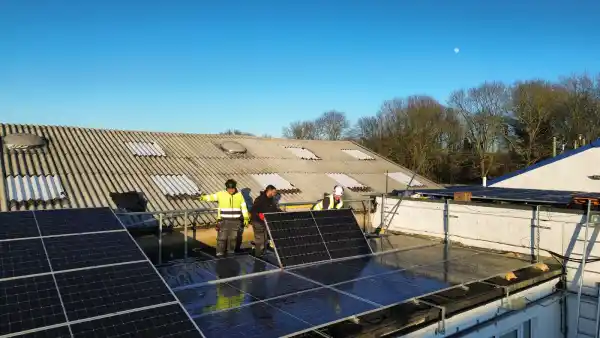
- PV installation at the Learn Trade Skills centre – our own training centre has solar PV installed on the building. The system was installed as part of a training project, giving students hands‑on experience of mounting, wiring, testing and commissioning a working array that still operates today.
Those projects are designed around the same standards and documents you see in the City & Guilds handbooks and MCS standards – BS 7671, IET Codes of Practice, MIS 3002/MIS 3012 – so what you learn in class lines up with what you’ll do on site.
7. How all this supports net zero and green jobs
The UK’s Net Zero Strategy and subsequent plans make it clear that decarbonising buildings and transport is essential to hit the 2050 target.
- EV infrastructure is expanding rapidly, backed by government guidance and official statistics series.
- Clean energy and net zero are at the heart of the government’s Clean Energy Jobs Plan, which identifies trades like electricians as central to the transition.
- The Green Jobs Taskforce report emphasises that every job has the potential to become “green” as the economy decarbonises, and that the skills system must support that shift.
For you as an electrician, that means:
- There’s a long‑term demand for people who can design and install EV chargers, PV systems and batteries safely and compliantly.
- Regulated qualifications like City & Guilds 2921, 2922 and 2923 put you on the right side of industry expectations and scheme requirements.
- Projects like Holland Bazaar and our own PV installation show how training can be directly linked to real net zero infrastructure.
8. FAQs – Renewable installation courses in the UK (EV, PV, EESS)
1. Do I have to be an ECS Gold Card holder to take EV, PV or EESS courses?
No – but you must meet the same technical level.
City & Guilds says you must hold either:
- a recognised Level 3 electrotechnical qualification (NVQ/apprenticeship or equivalent, as listed in the EAS), or
- an ECS Gold Card (Installation, Maintenance or Domestic Electrician).
If you already have a Level 3 NVQ plus current BS 7671, you don’t have to hold the physical Gold Card to attend the course.
2. Do I need to be registered with a Competent Person Scheme (CPS) before doing a renewable course?
No.
The City & Guilds learner entry requirements for 2921, 2922 and 2923 do not mention CPS membership.
CPS registration becomes important when you want to self‑certify notifiable domestic work under the Building Regulations, and their criteria are based on the EAS.
3. Are the City & Guilds EV, PV and EESS courses officially regulated?
Yes.
- City & Guilds is a regulated awarding organisation on the Ofqual register.
- The 2921, 2922 and 2923 qualifications are Ofqual‑regulated Level 3 awards, and you can verify them via the “Find a regulated qualification” service on GOV.UK.
4. Are these courses enough on their own to start a renewables business?
They’re an important part of the picture, but not the whole picture.
To run a business installing EV chargers, PV or batteries, you will usually need:
- Appropriate core electrical competences (Level 3 NVQ + BS 7671).
- Relevant renewables qualifications (e.g. C&G 2921/2922/2923 or equivalent).
- Membership of a Competent Person Scheme for notifiable domestic work.
- For PV/EESS projects seeking MCS certification, your business must meet MCS requirements (MIS 3002/MIS 3012 and MCS‑001).
So the courses are necessary but not sufficient for many routes.
5. How long do these courses usually take?
City & Guilds gives Guided Learning Hours (GLH) and Total Qualification Time (TQT):
- 2921‑34 (EV domestic/small commercial): 15 GLH, 19 TQT
- 2922‑34 (Solar PV): 22 GLH, 30 TQT
- 2923‑34 (EESS): 15 GLH, 22 TQT
Training centres (including LTS) translate that into short intensive courses, typically delivered over several days, but exact timetables vary by provider.
6. Will these skills still be relevant in 5–10 years?
All the indicators say yes:
- The UK’s legally binding net zero 2050 target is not going away.
- EV charging infrastructure is continuing to grow, with official statistics published every quarter.
- Government strategies on clean energy jobs, net zero and green skills regularly highlight electricians and related trades as core occupations.
7. Can a non‑electrician jump straight into these courses?
According to City & Guilds, no.
All three qualifications explicitly require learners to be practising electricians with Level 3 electrotechnical competence or ECS Gold Card, and they are written as CPD, not as entry‑level electrician training.
If you’re a new entrant, your route is:
- Complete a recognised Level 3 electrotechnical qualification (e.g. apprenticeship + NVQ).
- Gain practical experience and, ideally, an ECS Gold Card.
- Then take EV/PV/EESS CPD courses.
8. Are there funding or government incentives linked to these skills?
Government support for renewables and EV infrastructure is ongoing (for example, EV charging grants and wider clean‑energy investment programmes), and the electric vehicle charging device grant scheme statistics series tracks the grants awarded for charge‑point installations.
However, funding for training courses is more patchwork – often through local skills initiatives or employer funding rather than national schemes. You’ll need to check what’s available in your area at the time you apply.
9. Final thoughts from me as a lecturer
As an electrician, I’ve watched the trade change from purely “wires and boards” to include smart systems, EVs, PV, storage and grid interaction. As a lecturer of over 20 years, I see that the electricians who thrive are those who:
- anchor themselves in regulated core competence (Level 3 + BS 7671),
- build renewables CPD on top (EV, PV, EESS), and
- understand how their work fits into the UK’s net zero journey.
At Learn Trade Skills, our City & Guilds EV (2921), PV (2922‑34) and EESS (2923‑34) courses are built to sit exactly in that space: aligned with Ofqual, EAS, ECS, MCS and the IET Codes of Practice – and backed up with real projects like Holland Bazaar and our own PV system at the centre.
If you meet the Level 3 / ECS Gold Card requirements and you’re serious about working in renewables, these qualifications are a solid, regulated route into a growing part of the industry.
Sources
UK Government, Net Zero and EV Infrastructure
Qualifications and Regulation (Ofqual, City & Guilds, ECS/JIB, EAS)
Microgeneration Certification Scheme (MCS) and Technical Standards
Sezai Aramaz is the esteemed founder of Learn Trade Skills, boasting over 40 years of experience in the electrical industry in the UK. With two decades dedicated to educating future electricians, he served as an Electrical Installation Lecturer and Assessor. Aramaz's expertise and commitment have contributed significantly to the growth and proficiency of aspiring tradespeople in the field.